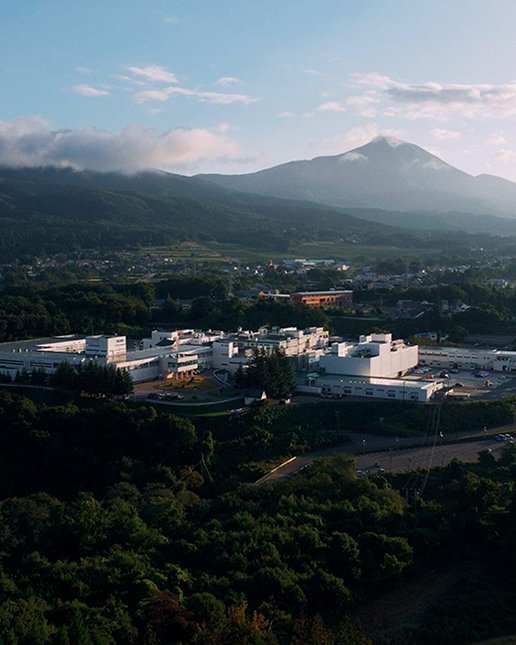
Manufacturing
For our manufacturing, we believe there are things more important than any of the technologies involved. One is the constant will to explore and challenge new technologies and innovations. Then, in order to turn these challenges into reality, there is our manufacturing base in Aizu; engineers who constantly explore technological innovations; skilled workers who continue to pursue accuracy and perfection. The interaction of different departments, skills and technologies is the engine behind Sigma’s unique products and manufacturing.
core technologies
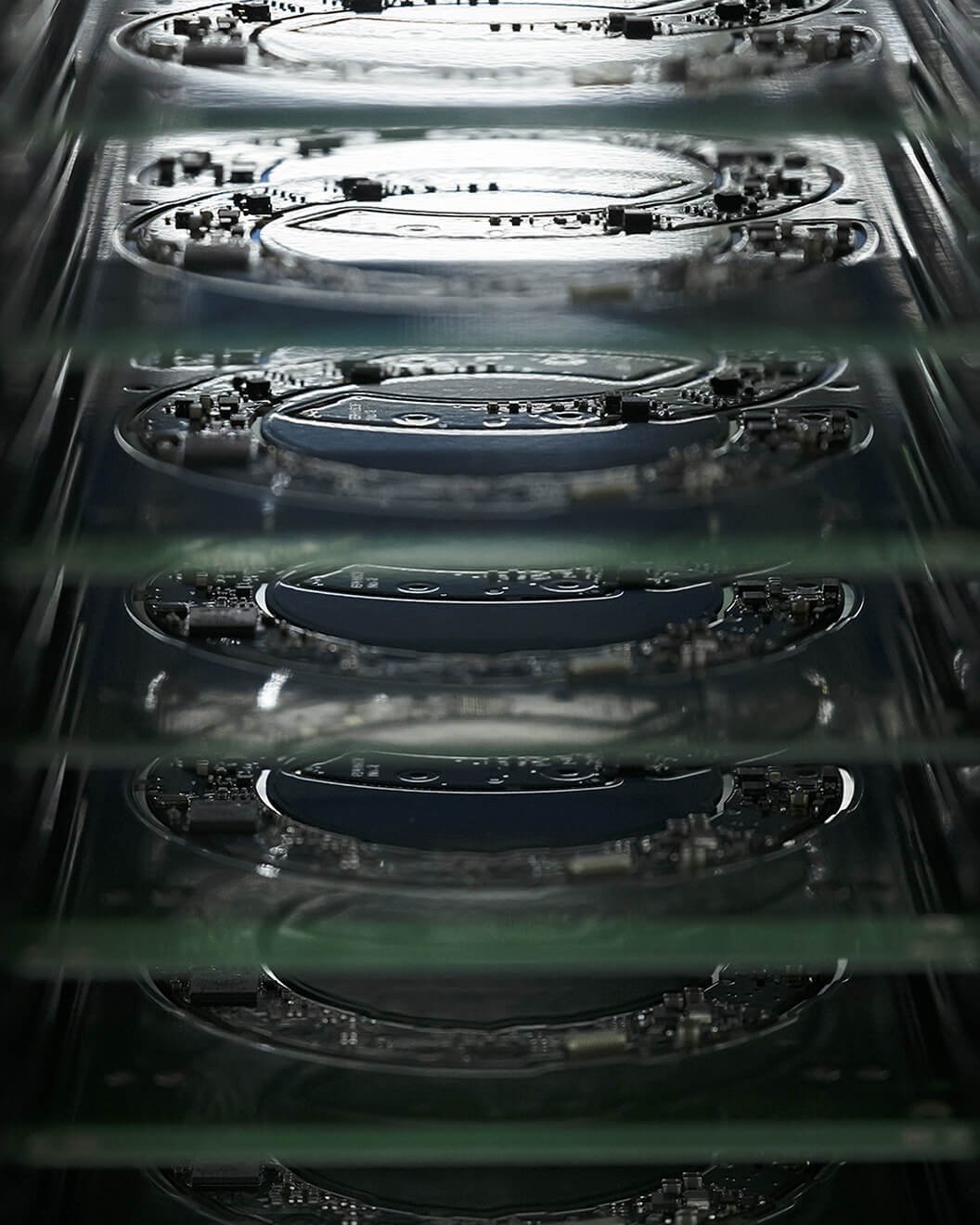
Sigma’s core technologies are separated into three broad categories: development, manufacturing at our Aizu factory, and services. Together, they are the source of our digital cameras, lenses, accessories and software. Sigma’s unique products and services make use of inspirations and ideas that cannot be achieved within the confines of single branches but only through interactions between different specialized fields. Also, by handling each process, from research to development, manufacture and after-sales service ourselves, Sigma is able to accumulate a wealth of expertise and experience, which again helps us develop new ideas and technologies.
Small office, big factory
This phrase accurately describes Sigma’s unique production system and has been one of our fundamental principles since our foundation. Many of our products begin by following ideas such as “here’s a lens we would like to make” or “this would be the perfect product for us to create.” A highly-developed manufacturing technology is an indispensable requirement for turning such ideas into reality. A sharp sense of creativity paired with the power of a rich manufacturing system able to give shape to new thoughts. At Sigma, this balance is an integral part of our corporate philosophy.
a closely-linked business chain
Sigma’s production system is completely based in Japan: our compact supply chain is concentrated in the Tohoku region and almost all manufacturing, processing and assembly takes place at our manufacturing base in Aizu. This is an extraordinary setup in an industry that mostly favors “global procurement”, in other words sourcing the cheapest parts from around the world. Why do we insist on manufacturing domestically, despite higher costs? Because we believe such a domestic system to be an essential factor for creating unique and high-quality products.
The direct, face-to-face communication made possible by having our manufacturing site, our head office and our supply chain based in one single country also enables a speedy and meticulous product development. And because the same people are consistently involved in our manufacturing processes, they are able to accumulate a wealth of experience, knowledge and know-how from which new ideas and innovations can spring.
These are merits that cannot be acquired with money alone, and we believe them to be our greatest asset. That is why a domestic, fully integrated production system is so important to us.
Lenses and cameras
Following the constant improvements in resolution and multi-functionality of digital cameras, interchangeable lenses are also expected to deliver ever higher performance. Rapid technological advances are difficult to achieve. Instead, innovation is built on optical design, which relies on an accumulation of technology; on software that constantly needs to catch with with the latest technologies; and on mechanical design that brings everything together. Technical know-how as well as engineers with experience are an integral part of each step.
Camera development is the other foundation of Sigma’s manufacturing. With unique cameras such as the Quattro series and its Foveon sensor — the only sensor with vertical color separation in the world — or the small, lightweight full-frame fp series, Sigma has established its own unique image processing, software and mechanical design technologies.
Above all, designing and manufacturing lenses and cameras, the two fundamental tools of photography allows us to constantly consider, examine and re-examine the essential fun and pleasure of taking pictures from the standpoint of the photographer. Lenses and cameras. The pillars of Sigma’s business principle and philosophy of photography.
The scenic route to perfection
"Like water through a river"
This was the standard set by Michihiro Yamaki, Sigma’s original founder, for the production process. He often uttered these words during his visits to the factory in Aizu, ensuring that all operations flowed smoothly, like water through a river.
200 different models
Currently, no single unifying mount exists for all interchangeable camera systems on the market. As a result, based on the model numbers of our manufacturing plan, we produce around 200 lens variations at our Aizu factory.
High-precision polishing technology
Sigma’s spherical lenses are manufactured with an extraordinarily precise surface roughness of just 2 micrometers. Surface roughness refers to the deviation from an ideal, smooth surface. If a lens were scaled up to a diameter of 300 kilometers – the distance between Tokyo and Aizu – the largest bulge would be less than 2 centimeters.
From 10mm to 198mm
The largest single lens we produce is the front element of the APO 200-500mm F2.8 EX DG, with a diameter of 198mm. Applying its lens coating takes a meticulous eight hours.
In contrast, the smallest single lens in our lineup is the 7th element of the 8-16mm F4.5-5.6 DC HSM zoom lens, measuring just 10mm.
* As of 2017
Three minutes, three letters
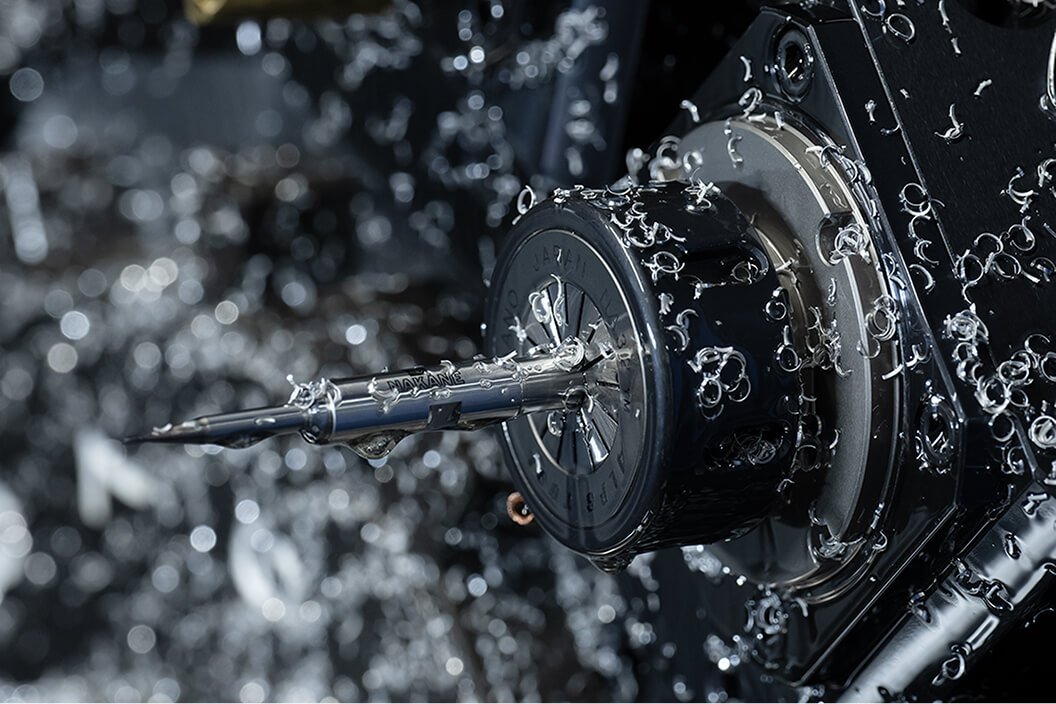
With the introduction of Sigma Global Vision in 2012, we began engraving a three-digit code onto each lens. This code marks the release year of the model. Our hope is that this detail helps customers form a deeper connection with their product by situating it within Sigma’s production history–much like vintage wine.
The three-digit code is engraved using an exceptionally fine end mill. This process is carried out with great care and takes approximately three minutes per lens.
Bayonets without compromise
Our brass bayonets are manufactured with thick chrome plating to ensure a quality finish that is resistant to scratches. We adopted trivalent chromium into our production process as soon as it became industrially available. Trivalent chromium perfectly meets our needs for plating without exceeding 0.5 micrometers in thickness. By abandoning the highly toxic hexavalent chromium, we can prioritize the health of our workers and minimize the environmental impact of our factory.
"Five more micrometers!"
When designing and producing molds, the finishing process is reviewed in thorough detail. For fine adjustments, we commonly work in units of micrometers (0.000001m).
Sigma's proprietary MTF measuring system with data of all shipping lenses
Since the introduction of Sigma Global Vision in 2012, each individual lens shipped has been measured and quality controlled using Sigma’s proprietary MTF measuring device. Precise measurement data for every lens is stored at our facility in Aizu.
Beyond measuring capabilities
We place great emphasis on the processing technologies used to manufacture molds for parts that demand absolute precision, such as lens cells. With manufacturing deviations never exceeding 0.002mm, the accuracy of the machines at our Aizu factory surpasses even that of state-of-the-art ultrahigh precision 3D measuring devices. We are committed to achieving the highest precision at every step of the process – beyond the reach of modern measuring capabilities.
Tactile perfection
Our quality control department ensures the optimal performance and flawless visual appearance of each product. Additionally, they assess crucial qualities that can’t be easily quantified, such as the smoothness of the zoom and focus rings. Our evaluation standards are incredibly strict–to the extent that products can be rebuilt if “the ring doesn’t quite feel right”.